Saturday, January 29, 2022

Podcast Episode 31 - Stubborn Nags of Ancient Rome, Part VII

It’s almost like Cato the Younger had no idea he was putting his head in the lion’s mouth.

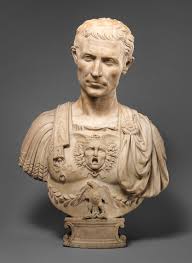
In the space of two years he had managed to get on the wrong side of Julius Caesar, Rome’s up and coming populist leader, Pompey the Great, Rome’s greatest living general, Marcus Crassus, Rome’s richest man, and Marcus Tullius Cicero, who had been Rome’s most recent consul, and for a few minutes there, the man with near-absolute power over the state during the Catiline Conspiracy.

Stubborn sticks in the mud like Cato are not impressed with anyone. This is what makes them formidable.

And dangerous.

Caesar, Pompey and Crassus were on a path to power that would ultimately end the Roman Republic.

Cato the Younger was standing firmly in their way, and he had to go. One way or another.


Sources

Beard, Mary. “SPQR.” Profile Books, 2015.

Duncan, Mike. “The Storm Before the Storm: The Beginning of the End of the Roman Republic.” Public Affairs, 2017.

Everitt, Anthony. “Cicero: The Life and Times of Rome’s Greatest Politician.” Random House, 2011.

Goodman, Rob and Soni, Jimmy. “Rome’s Last Citizen: The Life and Legacy of Cato, Mortal Enemy of Caesar.” St. Martin’s Press, 2012.
Saturday, January 22, 2022

Podcast Episode 30 - Stubborn Nags of Ancient Rome, Part VI

The battle for the fate of the Roman Republic was on.

On one side were the empire-builders: Julius Caesar and his right-hand man Marc Antony (and sickly little Octavian in the next tent), Pompey the Great, and Marcus Crassus, who wanted to be great himself but never quite got there.

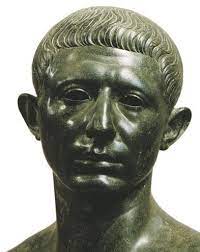
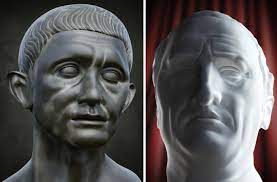
On the other side were Marcus Tullius Cicero, Rome’s greatest orator, consul in 63 BC, dictator during the Catiline Conspiracy, and all-around clever guy. At his side was Rome’s greatest conservative and champion of ancient ideals, Cato the Younger.

They also had in their corner—at least on paper--the cowardly Roman Senate, but being cowardly--and venal--the Senate was always kind of a moving target. They could be bought and they could be intimidated, and the empire-builders had money and soldiers to burn.


It was a contest between military power, which the Romans had always admired, and republican traditions, which the Romans had always revered. But the citizens of the republic saw their ideals go to the Senate house to die more often than not, and might be willing to take a chance on a smooth operator like Caesar, who claimed to be a staunch defender of the republic even as he quietly dismantled it.

Cicero and Cato had their work cut out for them.


Sources
Beard, Mary. “SPQR.” Profile Books, 2015.

Duncan, Mike. “The Storm Before the Storm:  The Beginning of the End of the Roman Republic.” Public Affairs, 2017.

Goodman, Rob and Soni, Jimmy. “Rome’s Last Citizen: The Life and Legacy of Cato, Mortal Enemy of Caesar.” St. Martin’s Press, 2012.
Wikipedia, “Cicero.” Retrieved December 2, 2021 from https://en.wikipedia.org/wiki/Cicero


Saturday, January 15, 2022

Podcast Episode 029 - Stubborn Nags of Ancient Rome, Part V

“Who is better qualified to be the standard-bearer of the desperate,” the insurgent Catiline asked his massed followers, “than a man who is bold and desperate himself?”

Well, Catiline. You make a good point there.

His army waited out past the walls of Rome, ready to pounce. His supporters waited inside the city, ready to set fires to stuff and purge their enemies. 

Ambitious young Gaius Julius Caesar waited to see which way the wind was blowing, looking for an advantage.

One of the only men standing against them was Cato the Younger.

Cato and Cicero

He had his work cut out for him - prevent Catiline's insurrection from succeeding (and keep Rome from falling into another bloody dictatorship). Keep Julius Caesar at bay, and do everything he could to preserve the institutions and traditions of the Roman Republic for as long as he could. 

Good luck, Cato. 


Sources
Beard, Mary. “SPQR.” Profile Books, 2015.

Britannica.com. “Catiline: Roman Politician.” Retrieved 1/1/2022 from https://www.britannica.com/biography/Catiline-Roman-politician

Duncan, Mike. “The Storm Before the Storm: The Beginning of the End of the Roman Republic.” Public Affairs, 2017.

Goodman, Rob and Soni, Jimmy. “Rome’s Last Citizen: The Life and Legacy of Cato, Mortal Enemy of Caesar.” St. Martin’s Press, 2012.
Penn State University. “The Catilinarian Conspiracy.” Retrieved 1/1/2022 from https://sites.psu.edu/conspofcatiline/

Wikipedia, “Cicero.” Retrieved December 2, 2021 from https://en.wikipedia.org/wiki/Cicero


Saturday, January 8, 2022

Podcast Episode 28 - Teddy Roosevelt's Third Term, Conclusion

A message was sent from Paris in the summer of 1918 to American news agencies.

“Watch Sagamore Hill in event of...”

The rest of the message had been deleted by wartime censors, but Theodore Roosevelt knew what it meant.

He said, “Something has happened to one of the boys.”


All the Roosevelt sons were fighting in World War I without their dad, who had been prevented from going by Woodrow Wilson. The last thing the president wanted was Theodore Roosevelt back on the world stage before he himself could get there. 

Teddy was sidelined by illness and sadness, made worse by the fates of his children. But the possibility of  a return to the White House in 1920 got more realistic as Wilson stumbled. 

If only Teddy could make it.


Sources

American Magazine. “The Reformers. Retrieved December 29, 2021 from https://www.americamagazine.org/issue/culture/reformers

HistoryNet. “Aviators: Quentin Roosevelt – He Died Fighting.” Retrieved December 29, 2021 from https://www.historynet.com/aviators-quentin-roosevelt-he-died-fighting.htm

Morris, Edmund. “Colonel Roosevelt.” Random House, 2010.

Roosevelt, Theodore. “Autobiography of Theodore Roosevelt.”

Wikipedia. “1918 United States Elections.” Retrieved 12/31/21 from https://en.wikipedia.org/wiki/1918_United_States_elections

Wikiquote. “Thomas R. Marshall.” Retrieved 12/31/21 from https://en.wikiquote.org/wiki/Thomas_R._Marshall


Friday, December 31, 2021

Podcast Episode 27 - Teddy Roosevelt's Third Term, Part XI


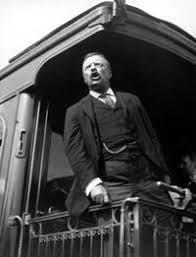
There was no way Woodrow Wilson was going to let former President Theodore Roosevelt anywhere near Europe during the First World War.

Teddy had made multiple requests to War Secretary Newton Baker, asking permission to raise a division of volunteers, with himself as a major general, "to put our flag on the firing line."


But what Wilson actually feared was that Teddy, upon his arrival in Europe, would be drafted into chairing a peace conference. By 1916 the military situation had reached a stalemate of trench warfare and pointless killing. The Germans had made some initial peace overtures. 

If the man who had successfully negotiated an end to the Russo-Japanese War only a decade earlier showed up, the "vital hold which personalities like Roosevelt have on popular imagination," as Georges Clemenceau told Wilson, might just get all the warring parties to the peace table and end the war. 

Woodrow Wilson, who lacked Teddy's "vital personality" and international stature, did all he could to keep Teddy home. 

If Teddy couldn't fight, he was going to send his four sons in his place. 


Sources

American Magazine. “The Reformers." Retrieved December 29, 2021 from https://www.americamagazine.org/issue/culture/reformers

HistoryNet. “Aviators: Quentin Roosevelt – He Died Fighting.” Retrieved December 29, 2021 from https://www.historynet.com/aviators-quentin-roosevelt-he-died-fighting.htm

Morris, Edmund. “Colonel Roosevelt.” Random House, 2010.

Roosevelt, Theodore. “Autobiography of Theodore Roosevelt.” 


Sunday, December 26, 2021

Podcast Episode 26 - Teddy Roosevelt's Third Term, Part X


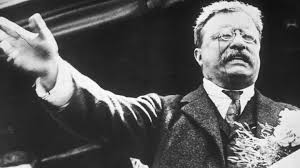
Theodore Roosevelt was down in the dumps in 1916. The world was on fire. The country, with either Wilson or Hughes destined for the White House, was “in the hands of two aloof and cagey deliberators. Wilson and Hughes were men who waited for events to happen and then reacted.” Teddy saw things coming, and got ready.

But as happened in 1912, Teddy allowed his candidacy, and his potential third term, to be derailed in the “smoke-filled room” of the nominating convention. He let party insiders, many with presidential ambitions of their own, talk him out of running, and he surely didn’t help himself by doing the same thing he accused Wilson of doing in Mexico: taking one step forward and two steps back.


He forgot that his true power came from the American people. In time of war, the best argument to get or retain the presidency was experience in office—it was an argument Teddy’s “fifth cousin by blood and nephew by marriage” would use decades later to win four terms in the White House. In 1916, only two men had the kind of experience the country knew it needed—Wilson and Roosevelt.

But Teddy allowed his emotions to get in the way, and his political shrewdness and canny assessment of the mood of the people was lost in a wave of self-pity. 1904 Theodore Roosevelt went after what he knew to be best for the nation. 1916 Teddy waited to be asked, not by the people, but by cynical party insiders. And he let his temper get the best of him.

As President Wilson had once said about Teddy, “The way to treat an adversary like Roosevelt is to gaze at the stars over his head.”

Woodrow Wilson’s chances in 1916 were looking pretty good.


Sources

History. “U.S. Entry Into World War I.” Retrieved December 22, 2021 from https://www.history.com/topics/world-war-i/u-s-entry-into-world-war-i-1

Morris, Edmund. “Colonel Roosevelt.” Random House, 2010.

Morris, Edmund. “Theodore Rex.” Simon & Schuster, 2006.

Roosevelt, Theodore. “Autobiography of Theodore Roosevelt.”

Wikipedia, “United States Involvement in the Mexican Revolutuion.” Retrieved December 24, 2021 from https://en.wikipedia.org/wiki/United_States_involvement_in_the_Mexican_Revolution


Saturday, December 11, 2021

Podcast Episode 25 - Stubborn Nags of Ancient Rome - Part IV


Rome’s greatest orator pointed his finger at Cato the Younger and said, “Do you not see a storm coming?”


Marcus Tullius Cicero was consul for the year 63 BC, and thanks to the aforementioned storm, was a virtual dictator. But he had a number of problems, and he was going to use Cato the Younger to try and solve them.

Here’s the thing: it wasn’t just one storm.


Cato ran for his first office in 67 BC—military tribune. This would put him in command of a legion of about four thousand troops and pave his way to a Senate seat when his year was up.

 He campaigned for his first office at a time when the average Roman-on-the-street was feeling pretty nervous about the state of the Republic. Rome’s success had come, in part, from its ability to learn and adapt, to see what worked and make it their own. Military formations and tactics, education, politics, engineering, territorial conquest and management—the Romans were great learners. The problem was that the lessons currently being taught were the ones that would ultimately end the Republic.

He won his election and went to take command. Like his famous great-grandpa, he shared his men's hardships and they loved him for it. 

When the year was up, he went back to Rome and took over the Treasury, calling in old debts and paying off others. But his moral handling of the public trust didn't survive past his term in office. 

Back in the throes of corruption, a new populist arose - Catiline - who proposed cancelling all debts and redistributing land to the poor. The elite of Rome freaked out, and backed another "man of the people" candidate to beat him - Cicero, Rome's greatest orator. 

But Catiline didn't give up, and planned to take the city by force.

Cicero and Cato were going to have to team up to stop him. 

Sources 

Beard, Mary. “SPQR.” Profile Books, 2015.

Duncan, Mike. “The Storm Before the Storm: The Beginning of the End of the Roman Republic.” Public Affairs, 2017.

Goodman, Rob and Soni, Jimmy. “Rome’s Last Citizen: The Life and Legacy of Cato, Mortal Enemy of Caesar.” St. Martin’s Press, 2012.
Wikipedia, “Cicero.” Retrieved December 2, 2021 from https://en.wikipedia.org/wiki/Cicero

Wikipedia, “Cato the Elder.” Retrieved September 14, 2021 from https://en.wikipedia.org/wiki/Cato_the_Elder.

Wikipedia, “Gaius Marius.” Retrieved September 14, 2021 from https://en.wikipedia.org/wiki/Gaius_Marius

Wikipedia, “Spartacus.” Retrieved December 11, 2021 from https://en.wikipedia.org/wiki/Spartacus

Wikipedia, “Stoicism.” Retrieved November 4, 2021 from https://en.wikipedia.org/wiki/Stoicism

Wikipedia, “Sulla.” Retrieved September 14, 2021 from https://en.wikipedia.org/wiki/Sulla