Showing posts with label World War I. Show all posts

Saturday, January 8, 2022

Podcast Episode 28 - Teddy Roosevelt's Third Term, Conclusion

A message was sent from Paris in the summer of 1918 to American news agencies.

“Watch Sagamore Hill in event of...”

The rest of the message had been deleted by wartime censors, but Theodore Roosevelt knew what it meant.

He said, “Something has happened to one of the boys.”
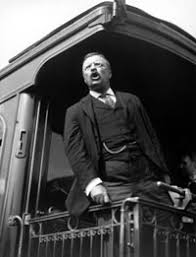


All the Roosevelt sons were fighting in World War I without their dad, who had been prevented from going by Woodrow Wilson. The last thing the president wanted was Theodore Roosevelt back on the world stage before he himself could get there. 

Teddy was sidelined by illness and sadness, made worse by the fates of his children. But the possibility of  a return to the White House in 1920 got more realistic as Wilson stumbled. 

If only Teddy could make it.


Sources

American Magazine. “The Reformers. Retrieved December 29, 2021 from https://www.americamagazine.org/issue/culture/reformers

HistoryNet. “Aviators: Quentin Roosevelt – He Died Fighting.” Retrieved December 29, 2021 from https://www.historynet.com/aviators-quentin-roosevelt-he-died-fighting.htm

Morris, Edmund. “Colonel Roosevelt.” Random House, 2010.

Roosevelt, Theodore. “Autobiography of Theodore Roosevelt.”

Wikipedia. “1918 United States Elections.” Retrieved 12/31/21 from https://en.wikipedia.org/wiki/1918_United_States_elections

Wikiquote. “Thomas R. Marshall.” Retrieved 12/31/21 from https://en.wikiquote.org/wiki/Thomas_R._Marshall
Friday, December 31, 2021

Podcast Episode 27 - Teddy Roosevelt's Third Term, Part XI


There was no way Woodrow Wilson was going to let former President Theodore Roosevelt anywhere near Europe during the First World War.

Teddy had made multiple requests to War Secretary Newton Baker, asking permission to raise a division of volunteers, with himself as a major general, "to put our flag on the firing line."


But what Wilson actually feared was that Teddy, upon his arrival in Europe, would be drafted into chairing a peace conference. By 1916 the military situation had reached a stalemate of trench warfare and pointless killing. The Germans had made some initial peace overtures. 

If the man who had successfully negotiated an end to the Russo-Japanese War only a decade earlier showed up, the "vital hold which personalities like Roosevelt have on popular imagination," as Georges Clemenceau told Wilson, might just get all the warring parties to the peace table and end the war. 

Woodrow Wilson, who lacked Teddy's "vital personality" and international stature, did all he could to keep Teddy home. 

If Teddy couldn't fight, he was going to send his four sons in his place. 


Sources

American Magazine. “The Reformers." Retrieved December 29, 2021 from https://www.americamagazine.org/issue/culture/reformers

HistoryNet. “Aviators: Quentin Roosevelt – He Died Fighting.” Retrieved December 29, 2021 from https://www.historynet.com/aviators-quentin-roosevelt-he-died-fighting.htm

Morris, Edmund. “Colonel Roosevelt.” Random House, 2010.

Roosevelt, Theodore. “Autobiography of Theodore Roosevelt.” 


Sunday, December 26, 2021

Podcast Episode 26 - Teddy Roosevelt's Third Term, Part X


Theodore Roosevelt was down in the dumps in 1916. The world was on fire. The country, with either Wilson or Hughes destined for the White House, was “in the hands of two aloof and cagey deliberators. Wilson and Hughes were men who waited for events to happen and then reacted.” Teddy saw things coming, and got ready.

But as happened in 1912, Teddy allowed his candidacy, and his potential third term, to be derailed in the “smoke-filled room” of the nominating convention. He let party insiders, many with presidential ambitions of their own, talk him out of running, and he surely didn’t help himself by doing the same thing he accused Wilson of doing in Mexico: taking one step forward and two steps back.


He forgot that his true power came from the American people. In time of war, the best argument to get or retain the presidency was experience in office—it was an argument Teddy’s “fifth cousin by blood and nephew by marriage” would use decades later to win four terms in the White House. In 1916, only two men had the kind of experience the country knew it needed—Wilson and Roosevelt.

But Teddy allowed his emotions to get in the way, and his political shrewdness and canny assessment of the mood of the people was lost in a wave of self-pity. 1904 Theodore Roosevelt went after what he knew to be best for the nation. 1916 Teddy waited to be asked, not by the people, but by cynical party insiders. And he let his temper get the best of him.

As President Wilson had once said about Teddy, “The way to treat an adversary like Roosevelt is to gaze at the stars over his head.”

Woodrow Wilson’s chances in 1916 were looking pretty good.


Sources

History. “U.S. Entry Into World War I.” Retrieved December 22, 2021 from https://www.history.com/topics/world-war-i/u-s-entry-into-world-war-i-1

Morris, Edmund. “Colonel Roosevelt.” Random House, 2010.

Morris, Edmund. “Theodore Rex.” Simon & Schuster, 2006.

Roosevelt, Theodore. “Autobiography of Theodore Roosevelt.”

Wikipedia, “United States Involvement in the Mexican Revolutuion.” Retrieved December 24, 2021 from https://en.wikipedia.org/wiki/United_States_involvement_in_the_Mexican_Revolution