Friday, June 24, 2022

Podcast Episode 42 - Ben Franklin In The Cockpit, Part I

England’s American colonists were a serious problem for the British Empire by 1774. Mad old King George was pretty…well…you know. 

Great Britain was the world’s foremost military power, which meant it had bills to pay. The American colonies were prosperous, what with all their self-starting go-getterism, so Parliament and the king decided they should bear some of the financial burden of being subjects of the world’s foremost military power.

England did, after all, kick the French out of Canada and the land east of the Mississippi, which opened all that territory for development by the colonists.

Here’s your bill, said the King.


The resulting taxes got the colonists all in an uproar. Things were set on fire and Boston Harbor was turned into the world's biggest tea kettle. 

Ben Franklin, the most famous American in the world, was in London, and he became a handy target for all the pent-up frustration the British Empire had with its uppity provincials. 

He was summoned to appear before the King's Privy Council in 1774 to take a beating in a room Henry VIII had once used for cockfights. The British Solicitor General spent an hour tearing Franklin to shreds. 

Ben Franklin stood in silence the entire time. 

It is said that he went into the Cockpit an Englishman and came out an American.


Sources

Isaacson, Walter. “Benjamin Franklin: An American Life.” Simon and Schuster, 2003.

Skemp, Sheila L. “The Making of Patriot: Benjamin Franklin at the Cockpit.” Oxford University Press, 2013.



Monday, June 6, 2022

Podcast Episode 41 - The First Secretary of the Navy

We’re doing something special this week on History’s Trainwrecks. I was recently interviewed on the Presidencies of the United States Podcast about the first Secretary of the Navy, Benjamin Stoddert. Host Jerry Landry has a special series of episodes about Cabinet members called A Seat At The Table, in which he covers a Cabinet member and rates them based on a number of criteria.

He invites a fellow history podcaster on these shows to take a look at these often little-known historical figures, and he never tells his guest who the subject of the episode is until the tape starts rolling, so to speak, and it’s too late to back out.

It’s a lot of fun. Especially for Jerry.


As you might suspect, I knew nothing about Benjamin Stoddert, which is ok. There isn’t a lot of historical research available on him. It turns out he had a bit of a shady past, which was also a lot of fun.

But this episode has a surprise ending.

I hope you enjoy it, and check out nerds.historystrainwrecks.com for more on the Presidencies of the United States podcast. If you love history and are fascinated by the American Presidency, as I am, this show is for you.


Thursday, May 19, 2022

Podcast Episode 40 - The Most Dangerous Man In America, Part III


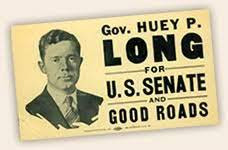
Huey Long had won a seat in the United States Senate while still in office as Louisiana’s governor.

Huey amassed dictatorial control over Louisiana in a very short time. He survived impeachment, neutralized his remaining opponents, and won a Senate seat. He became a driver of hard bargains. “He is always trying to trade us a biscuit for a barrel of flour,” one of his vanquished opponents complained.

While the state and the country was deep in economic trouble, Huey held singular control over state jobs and lucrative contracts. The men who opposed him faced a stark choice: get on board with Huey Long or brace for financial disaster.

Huey’s biggest problem with being the “Kingfish” of Louisiana was that he couldn’t leave the state.
 
His lieutenant governor, Paul Cyr, kept trying to assume the governorship, taking advantage of any time Huey crossed out of the state. Once Huey won a Senate seat, Cyr figured his claim on the governor's chair was assured. 

We'll just have to see about that. 


Sources

Long, Huey P. “My First Days In The White House.” Pickle Partners Publishing, 2016.

White, Richard D. “Kingfish: The Reign of Huey P. Long.” Random House, 2009.


Saturday, April 23, 2022

Podcast Episode 39 - Stubborn Nags of Ancient Rome, Conclusion

Julius Caesar tried to paint Cato the Younger’s suicide as the depraved final act of a crazed fanatic.

In the triumph he celebrated after his victory over the last Republican holdouts in North Africa, he had paintings carried through the procession showing Cato “tearing open his own wound.” All this did was engender sympathy for Cato, who killed himself rather than submit to Rome’s new tyrant, who was granted a dictatorship of ten years.

The Republicans who had accepted clemency from Caesar now began to feel ashamed that they had taken the easy way out. Cato’s nephew Brutus divorced his wife without explanation and married Porcia, Cato’s daughter. He wrote a book about his uncle-turned-father-in-law, praising his steadfast commitment to Republican virtues.

Brutus even managed to persuade Cicero to write his own story of Cato, but his book focused on his old ally’s “personal virtue and steadfastness rather than his political career.” Cicero, typically, was afraid of offending Caesar. He had also known Cato at his best and worst, and likely didn’t want to rehash their shared history, which would remind everyone that Cicero caved to a dictator to save himself and Cato did not. He much preferred Cato as a symbol than a living, righteous man, who more often than not rebuked Cicero for his own lack of righteousness.

Even watered-down, these books about Cato were not good for Caesar’s regime. “Within months of his suicide, one of Caesar’s bitterest opponents was being held up as the ideal of aristocratic virtue in books which were openly circulated and widely praised.”

This is just the kind of thing that would not have been tolerated when Sulla was dictator. Maybe Julius Caesar really wasn’t the best at everything.


Sources
Addison, Joseph. “Cato A Tragedy.” Delhi Open Books, 2022.

Beard, Mary. “SPQR.” Profile Books, 2015.

Goldsworthy, Adrian. “Caesar: Life of a Colossus.” Yale University Press, 2008.

Goodman, Rob and Soni, Jimmy. “Rome’s Last Citizen: The Life and Legacy of Cato, Mortal Enemy of Caesar.” St. Martin’s Press, 2012.


Saturday, April 9, 2022

Podcast Episode 38 - Stubborn Nags of Ancient Rome, Part XIV


Julius Caesar was finally ready to put an end to that pesky civil war.

His best legions had mutinied while he was away in Egypt consorting with Queen Cleopatra. He had left Rome in the hands of less-capable surrogates for about a year, which gave the remaining Republican resistance time and space to fortify the North African city of Utica, under the careful management of Cato the Younger.

Caesar had had enough. It was time to finish this once and for all.


After winning the Battle of Thapsus, Julius Caesar entered Utica to find Cato already dead and buried. He said, “I begrudge you your death, just as you begrudged me the chance to spare your life.”

Even though he had ultimately won the civil war, Caesar knew that he had been beaten.

Eighteen centuries later, when George Washington huddled with his men at Valley Forge, knowing that they were all that stood between an American republic and subjugation by a king,  Cato the Younger was the example he followed.

In defying Julius Caesar, Cato the Younger played a big part in the birth of democracies centuries later. 


Sources

Beard, Mary. “SPQR.” Profile Books, 2015.

Goldsworthy, Adrian. “Caesar: Life of a Colossus.” Yale University Press, 2008.

Goodman, Rob and Soni, Jimmy. “Rome’s Last Citizen: The Life and Legacy of Cato, Mortal Enemy of Caesar.” St. Martin’s Press, 2012.

Friday, April 1, 2022

Podcast Episode 037 - Stubborn Nags of Ancient Rome, Part XIII

The Roman Republic was making its last stand, but first it had to figure out who was in charge.

Not that it didn’t have bigger problems. Pompey the Great, thinking the civil war was over, failed to capitalize on his victory at the Battle of Dyrrhachium, allowing Julius Caesar all the time he needed to regroup so they could meet again at the Battle of Pharsalus in August of 48 BC.

Pompey did not win the Battle of Pharsalus.

After his crushing defeat, he retreated to Egypt, thinking he could get troops and money by picking a side in the ongoing incestuous power struggle between Cleopatra and her brother-husband, one of the last of the Ptolemaic kings. He picked the wrong side, and the Egyptians sent his severed head to Caesar, hoping that he would pick a side in the ongoing incestuous power struggle between Cleopatra and her brother-husband.

Julius Caesar would indeed pick a side, but that is a trainwreck for later.


He took some time off, managed to recover his mutinying legions, and headed for a final showdown in Africa.


Sources

Beard, Mary. “SPQR.” Profile Books, 2015.

Goldsworthy, Adrian. “Caesar: Life of a Colossus.” Yale University Press, 2008.

Goodman, Rob and Soni, Jimmy. “Rome’s Last Citizen: The Life and Legacy of Cato, Mortal Enemy of Caesar.” St. Martin’s Press, 2012.


Saturday, March 26, 2022

Podcast Episode 36 - Stubborn Nags of Ancient Rome, Part XII

Someone needed to rally the troops, and Rome’s greatest living general was having a hard time doing it.

Pompey the Great had a—well…great reputation as a commander, which his recruits and veterans alike could see for themselves. He trained and drilled right alongside them, and could swing a sword like a man half his age. But this time his troops weren’t just Romans—desperate times—and a civil war--had caused him to recruit men from the provinces instead of just Italy itself, and they were about to go to war against soldiers who had up until recently been on the same side.

If ever there was a time for an inspiring speech, this was it.


Sources

Beard, Mary. “SPQR.” Profile Books, 2015.

Duncan, Mike. “The Storm Before the Storm: The Beginning of the End of the Roman Republic.” Public Affairs, 2017.

Goodman, Rob and Soni, Jimmy. “Rome’s Last Citizen: The Life and Legacy of Cato, Mortal Enemy of Caesar.” St. Martin’s Press, 2012.

UNRV.com. “Battle of Dyrrhachium.” Retrieved March 21, 2022 from https://www.unrv.com/julius-caesar/battle-of-dyrrhachium.php

UNRV.com. “Battle of Pharsalus.” Retrieved March 21, 2022 from https://www.unrv.com/julius-caesar/battle-of-pharsalus.php