Saturday, July 30, 2022

Podcast Episode 45 - The Most Dangerous Man In America, Part IV

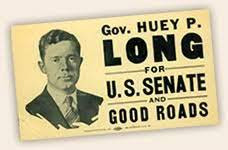
Huey Long was the bull in the United States Senate’s china shop.

He stormed into the world’s greatest deliberative body in 1932 after it had already been in session for two months. In a room full of men in dour blue suits, Huey wore “flashy brown tweeds, beautiful white shirts of the finest fabric with his monogram embroidered on one sleeve, a bright red silk necktie, and, according to one chastising reporter, ‘a handkerchief regrettably on the pink side.”

It wasn’t long, pun intended, before the Senate figured out that they had a real problem on their hands.

But soon enough there was another fellow in the capital who was even more worried about the storm from the bayou.

President Franklin Delano Roosevelt.


No one seemed to take Huey very seriously in the Roosevelt camp except for FDR himself. “The people are jumpy and ready to run after strange gods,” he wrote. “It’s all very well for us to laugh over Huey, but actually we have to remember all the time that he really is one of the two most dangerous men in the country. We shall have to do something about him.”

Franklin Roosevelt was certainly a visionary. He knew things for sure long before others came around to his point of view. He saw Huey Long as a self-obsessed man with huge ambitions who would stop at nothing to get what he wanted, even if it meant damaging the country. Like challenging Roosevelt for the nomination in 1936 or running as an independent, splitting the Democratic vote, and throwing the country to the Republicans for four years so that Huey could win the White House in 1940.

Which, as it turns out, was exactly what Huey Long was planning to do.


Sources

Long, Huey P. “My First Days In The White House.” Pickle Partners Publishing, 2016.

U.S. House Archives. “Hattie Wyatt Caraway.” Retrieved from https://history.house.gov/People/Listing/C/CARAWAY,-Hattie-Wyatt-(C000138)/ on July 29, 2022.

White, Richard D. “Kingfish: The Reign of Huey P. Long.” Random House, 2009.


Friday, July 8, 2022

Podcast Episode 44 - Ben Franklin In The Cockpit, Part II

The most famous American in the world was about to have one of the worst days of his life, and everyone who was anyone in London wanted to be there to see it.

Benjamin Franklin had been summoned to the Cockpit, a room King Henry VIII had once used for cockfighting, to appear before the King’s Privy Council in late January 1774. His ostensible purpose for being there was to deal with a petition sent by the Massachusetts colony to have their governor removed, but with the colonists getting all uppity and turning Boston Harbor into the world’s biggest teapot, the Council was going to take out all of its pent-up frustration with their cranky subjects on America’s best-known representative.


There’s no way to overstate the effect one hour in the Cockpit had on Benjamin Franklin. Up to that point he had been a strong advocate for peace between England and America, and his fame and reputation for wisdom was helpful in cooling tensions. His innovative way of thinking constantly came up with ways to smooth things over. He believed that the colonists’ notion that England was run by men who wanted to deprive them of liberty was “unduly paranoid.”

But after an hour in the Cockpit, Franklin believed that the King and his ministers could no longer be trusted. Had he not gone through the ordeal, he might have remained in London, working behind the scenes to forestall war and independence. After his trial he had little choice but to go back home. If the powerful Englishmen he had known and got along with could delight in the vicious attacks against Franklin, one of the most esteemed Americans alive, how would they ever see their colonists as equals and partners?

Always a smart fellow, Ben knew the answer to that one. Before the Cockpit, he had been working for both sides in the conflict between England and America. After, he was only working for one.

Sources
Isaacson, Walter. “Benjamin Franklin: An American Life.” Simon and Schuster, 2003.

Skemp, Sheila L. “The Making of Patriot: Benjamin Franklin at the Cockpit.” Oxford University Press, 2013.


Sunday, July 3, 2022

Podcast Episode 43 - I'm Not Allowed To Watch The News

As you surely know by now, I love history. I always have. If you do too, you know that studying history invariably leads to learning about politics.

It’s inescapable. The Greek city-states, the rise and fall of the Roman Empire, monarchies and religious wars, the Enlightenment that led to the establishment of constitutional democracies, the growth of superpowers.

Regionalism and factionalism and schisms and wars. If you study history, you’ve seen all this before.

This is one of the 257 reasons I’m not allowed to watch the news. I tend to rant, drawing historical parallels between today’s America and yesterday’s. It scares the dogs.

My wife said no more watching the news.

So the dogs and I started a new podcast, where I get to rant about all the things that bother me about 21st century politics. That’ll teach her.

For all you History’s Trainwrecks listeners, I’m putting out the first episode here. The rest will be available wherever you get your podcasts.

I hope you like it. And I hope we can find a way forward, politically-speaking.

Because if we’ve learned anything from history, it’s that situations like the ones we keep finding ourselves in do not end well.

Check out the first ever episode of I’m Not Allowed To Watch The News, and thanks for listening. 


Friday, June 24, 2022

Podcast Episode 42 - Ben Franklin In The Cockpit, Part I

England’s American colonists were a serious problem for the British Empire by 1774. Mad old King George was pretty…well…you know. 

Great Britain was the world’s foremost military power, which meant it had bills to pay. The American colonies were prosperous, what with all their self-starting go-getterism, so Parliament and the king decided they should bear some of the financial burden of being subjects of the world’s foremost military power.

England did, after all, kick the French out of Canada and the land east of the Mississippi, which opened all that territory for development by the colonists.

Here’s your bill, said the King.


The resulting taxes got the colonists all in an uproar. Things were set on fire and Boston Harbor was turned into the world's biggest tea kettle. 

Ben Franklin, the most famous American in the world, was in London, and he became a handy target for all the pent-up frustration the British Empire had with its uppity provincials. 

He was summoned to appear before the King's Privy Council in 1774 to take a beating in a room Henry VIII had once used for cockfights. The British Solicitor General spent an hour tearing Franklin to shreds. 

Ben Franklin stood in silence the entire time. 

It is said that he went into the Cockpit an Englishman and came out an American.


Sources

Isaacson, Walter. “Benjamin Franklin: An American Life.” Simon and Schuster, 2003.

Skemp, Sheila L. “The Making of Patriot: Benjamin Franklin at the Cockpit.” Oxford University Press, 2013.


Monday, June 6, 2022

Podcast Episode 41 - The First Secretary of the Navy

We’re doing something special this week on History’s Trainwrecks. I was recently interviewed on the Presidencies of the United States Podcast about the first Secretary of the Navy, Benjamin Stoddert. Host Jerry Landry has a special series of episodes about Cabinet members called A Seat At The Table, in which he covers a Cabinet member and rates them based on a number of criteria.

He invites a fellow history podcaster on these shows to take a look at these often little-known historical figures, and he never tells his guest who the subject of the episode is until the tape starts rolling, so to speak, and it’s too late to back out.

It’s a lot of fun. Especially for Jerry.


As you might suspect, I knew nothing about Benjamin Stoddert, which is ok. There isn’t a lot of historical research available on him. It turns out he had a bit of a shady past, which was also a lot of fun.

But this episode has a surprise ending.

I hope you enjoy it, and check out nerds.historystrainwrecks.com for more on the Presidencies of the United States podcast. If you love history and are fascinated by the American Presidency, as I am, this show is for you.


Thursday, May 19, 2022

Podcast Episode 40 - The Most Dangerous Man In America, Part III


Huey Long had won a seat in the United States Senate while still in office as Louisiana’s governor.

Huey amassed dictatorial control over Louisiana in a very short time. He survived impeachment, neutralized his remaining opponents, and won a Senate seat. He became a driver of hard bargains. “He is always trying to trade us a biscuit for a barrel of flour,” one of his vanquished opponents complained.

While the state and the country was deep in economic trouble, Huey held singular control over state jobs and lucrative contracts. The men who opposed him faced a stark choice: get on board with Huey Long or brace for financial disaster.

Huey’s biggest problem with being the “Kingfish” of Louisiana was that he couldn’t leave the state.
 
His lieutenant governor, Paul Cyr, kept trying to assume the governorship, taking advantage of any time Huey crossed out of the state. Once Huey won a Senate seat, Cyr figured his claim on the governor's chair was assured. 

We'll just have to see about that. 


Sources

Long, Huey P. “My First Days In The White House.” Pickle Partners Publishing, 2016.

White, Richard D. “Kingfish: The Reign of Huey P. Long.” Random House, 2009.


Saturday, April 23, 2022

Podcast Episode 39 - Stubborn Nags of Ancient Rome, Conclusion

Julius Caesar tried to paint Cato the Younger’s suicide as the depraved final act of a crazed fanatic.

In the triumph he celebrated after his victory over the last Republican holdouts in North Africa, he had paintings carried through the procession showing Cato “tearing open his own wound.” All this did was engender sympathy for Cato, who killed himself rather than submit to Rome’s new tyrant, who was granted a dictatorship of ten years.

The Republicans who had accepted clemency from Caesar now began to feel ashamed that they had taken the easy way out. Cato’s nephew Brutus divorced his wife without explanation and married Porcia, Cato’s daughter. He wrote a book about his uncle-turned-father-in-law, praising his steadfast commitment to Republican virtues.

Brutus even managed to persuade Cicero to write his own story of Cato, but his book focused on his old ally’s “personal virtue and steadfastness rather than his political career.” Cicero, typically, was afraid of offending Caesar. He had also known Cato at his best and worst, and likely didn’t want to rehash their shared history, which would remind everyone that Cicero caved to a dictator to save himself and Cato did not. He much preferred Cato as a symbol than a living, righteous man, who more often than not rebuked Cicero for his own lack of righteousness.

Even watered-down, these books about Cato were not good for Caesar’s regime. “Within months of his suicide, one of Caesar’s bitterest opponents was being held up as the ideal of aristocratic virtue in books which were openly circulated and widely praised.”

This is just the kind of thing that would not have been tolerated when Sulla was dictator. Maybe Julius Caesar really wasn’t the best at everything.


Sources
Addison, Joseph. “Cato A Tragedy.” Delhi Open Books, 2022.

Beard, Mary. “SPQR.” Profile Books, 2015.

Goldsworthy, Adrian. “Caesar: Life of a Colossus.” Yale University Press, 2008.

Goodman, Rob and Soni, Jimmy. “Rome’s Last Citizen: The Life and Legacy of Cato, Mortal Enemy of Caesar.” St. Martin’s Press, 2012.