Wednesday, September 8, 2021

Podcast Episode 13 - Ernest Hemingway's Last Penny

 Ernest Hemingway didn’t hate his mother, but he said some mean things about her.
 
He claimed that the money she spent on a summer cottage for herself could have been used to send him to college instead. He once told a friend that if his mother was a bird and flew in a straight line, he wouldn’t hesitate to shoot at her. After his father’s suicide, Hemingway wrote, “My mother is an all time all American bitch and she would make a pack mule shoot himself; let alone poor bloody father.”
 
Family Relationship Tip Number Two Hundred Fifty Seven: do not let Ernest Hemingway write your Mother’s Day cards. 


He was married four times. His first wife, Hadley, was a supportive and nurturing motherly type. But the other three wives were independent women with careers of their own. His second wife, Pauline Pfeiffer, worked for the magazines Vanity Fair and Vogue in Paris, which is where she and Ernest started the affair that broke up his first marriage. His third wife, Martha Gellhorn, was a writer and journalist who was known as one of the great war correspondents of the twentieth century. She met Ernest in 1936 in Key West, which is where she and Ernest started the affair that broke up his second marriage. His fourth wife, Mary Welsh, was a journalist for the London Daily Express. She met Ernest in 1944 while covering the Second World War, which is where she and Ernest started the affair that broke up his third marriage.
 
A certain pattern starts to emerge here: Ernest Hemingway was fond of independent, self-assured, career women like his mother.
 
He also seemed to enjoy getting sued for divorce on grounds of adultery.
 
Hemingway was a complicated guy. 
He was off covering the Spanish Civil War as a correspondent (and starting an affair with future third wife Martha Gellhorn) in 1937. The two had met in Key West the year before, and Pauline, knowing her husband like she did—and having a clear sense of history repeating itself, only with her playing the role of jilted spouse this time—suspected what the two of them were up to.
 
Pauline tore out her husband’s backyard boxing ring and built a massive in-ground swimming pool--24 feet wide and 60 feet long, with a 5-foot shallow end and a 10-foot deep end, all dug by hand through solid coral. There wasn’t enough water to fill it (nearly eighty-one thousand gallons was needed), so it was necessary to drill down to the salt water table to get enough water. It was the only pool within a hundred miles, and cost over $20,000 to build ($365,000 in 2020 dollars).
 
On a visit home, Hemingway was stunned by the cost overruns involved in pool construction. Pauline was likely unrepentant, suspecting what her philandering husband had been up to. Hemingway took a penny and flung it at her. It bounced off her shoulder and landed in the bottom of the pool.
 
“Pauline, you’ve spent all but my last penny,” Hemingway told her. “So you might as well have that.”
 
Pauline had the penny encased in plastic and mounted in the floor of the pool, where visitors to Hemingway’s Key West home can see it to this day.
 
But the costs kept coming. The pool had to be drained, cleaned, and refilled as often as every three days, using salt water pumps.
 
Philandering proved quite expensive for Ernest Hemingway: his first wife took the royalties for The Sun Also Rises, and his second wife took a couple years of his writing income to build a pool, then saddled him with the ongoing costs of its maintenance.
 
He would have been lucky to have gotten out of it for just a penny.

***

Check out the History's Trainwrecks Podcast at the links below:

Itunes:
https://itunes.apple.com/us/podcast/id1566357950?mt=2

Google Podcasts:
https://www.google.com/podcasts...


Sources


Hemingwayhome.com. “Our Pool and Garden.” Retrieved August 31, 2021 from https://www.hemingwayhome.com/our-architecture


Hutchisson, James M. “Ernest Hemingway: A New Life.” Penn State University Press, 2016.


Wikipedia, “Grace Hall Hemingway.” Retrieved August 31, 2021 from https://en.wikipedia.org/wiki/Grace_Hall_Hemingway


Wikipedia, “Martha Gellhorn.” Retrieved August 31, 2021 from https://en.wikipedia.org/wiki/Martha_Gellhorn


Wikipedia, “Mary Welsh Hemingway.” Retrieved August 31, 2021 from https://en.wikipedia.org/wiki/Mary_Welsh_Hemingway


Wikipedia, “Pauline Pfeiffer.” Retrieved August 31, 2021 from https://en.wikipedia.org/wiki/Pauline_Pfeiffer


Wednesday, September 1, 2021

Podcast Episode 12 - Fire In The Hole

Major General Ambrose Burnside was going to blow some stuff up.


Burnside led troops at the battles of the Wilderness and Spotsylvania Court House in a manner described as “reluctant.” He ended up at the Siege of Petersburg, which was the aftermath of Grant’s failed attempt to defeat Lee in a pitched, decisive battle. Both sides dug trenches and waited. Grant knew his opponent had lost men he could not replace, and supplies were running low. But Lee was clever, and Grant worried that the more time Lee had to strategize, the more likely it was that he might escape. 

The battles leading up to the siege were bloody and costly for the North, and Grant was called a “butcher” for his apparent willingness to sacrifice his men in inconclusive battles. General Grant had his own experience at the siege of Vicksburg to draw upon, where he had learned that sieges were expensive and bad for morale.

Like Burnside, Grant needed something big to turn things around. 
 
Colonel Henry Pleasants, a mining engineer from Pennsylvania, hatched a plan where he would dig a long shaft under the Confederate trenches, pack it with gunpowder, and blow the whole thing sky-high. This would open a massive hole in the Southern defenses that troops could pour through and attack.

This sounded great to Burnside. As long as the plan went off without a hitch. 


***


On our next episode, we’ll wade in to Ernest Hemingway’s complicated relationships with women and dig in to his views on swimming pool construction.

Not to be cliché, but it all started with his mother.

Stay tuned for Ernest Hemingway’s Last Penny.

Have a listen to the History's Trainwrecks Podcast at the links or embedded players below:

Like the show? Subscribe to the podcast and like or follow our Facebook page for more historical trainwrecks and their adventures.

Sources


American Battlefield Trust. “The Crater.” Retrieved August 30, 2021 from https://www.battlefields.org/learn/civil-war/battles/crater


Wikipedia, “Ambrose Burnside.” Retrieved August 29, 2021 from https://en.wikipedia.org/wiki/Ambrose_Burnside


Wikipedia, “Battle of Fredericksburg.” Retrieved August 29, 2021 from https://en.wikipedia.org/wiki/Battle_of_Fredericksburg


Wikipedia, “United States Joint Committee on the Conduct of the War.” Retrieved August 30, 2021 from https://en.wikipedia.org/wiki/United_States_Congressional_Joint_Committee_on_the_Conduct_of_the_War


Saturday, August 28, 2021

Podcast Episode 11 - Teddy Roosevelt's Third Term, Part V


Former President Theodore Roosevelt was in exile.

It was self-imposed, it was him doing the kinds of things he loved—hunting animals in the wild and being out in nature—and it was as far away from the United States as he could get.

He needed to get away from his successor, to whom he couldn’t help offering advice. About the way the public perceived Taft’s penchant for golf, his midday naps, and the appearance that if he moved at all, it was slow. That he should smile more, and get out among the people instead of cozying up to political cronies. “Lacking aggression, all [Taft] wanted was to be loved…he was everybody’s favorite fat uncle from childhood, dispensing coins and lollipops.”

The day after his decisive election, Taft went to play golf. One of his first statements to reporters as President-elect was, “I really did some great work at sleeping last night.” That quick, it became clear that this would be no energetic, proactive presidential administration.

Even though Teddy had anointed Taft President, he couldn’t trust himself to stick around and watch what happened next.

Teddy lecturing Kaiser Wilhelm II

***

He went to Africa under contract with the Smithsonian, to analyze flora and fauna, and send back exhibits and write scientific papers.

He was also, being Teddy, going to kill some big, scary animals before they got a chance to kill him.

When the trip was over, he looked around for what to do next.

Presidential Retirement Tip Number Two Hundred Fifty Seven: If you are fighting your impulses and ambition to keep yourself from running for president in an election you are pretty sure you can win, do NOT go on a European tour, where you will be treated like a visiting head of state by adoring crowds and European rulers.

A year after his departure from the White House, Theodore Roosevelt went on a European tour, where he was treated like a visiting head of state by adoring crowds and European rulers.

He saw firsthand the buildup of the German Army and Navy, and the apparent weakness of any European state that might oppose them. At the same time, reports of President Taft's ineptitude showed up in his daily mail.

He came back to New York in 1910, where he was met by a crowd of a million people, who howled "our next President!" at him from the sidewalks along his five mile parade route. One paper wrote that “Never before in the history of America has a private citizen possessed the power which Mr. Roosevelt now holds.”

Teddy went home to Oyster Bay, where he had a lot of thinking to do.

The presidential election of 1912 was approaching, and the next move was his.

***

On our next episode, we’ll take a break from Teddy Roosevelt’s conflicted musings about a triumphant return to power in 1912 and head to the Civil War siege of Petersburg in 1864. General Grant’s attempt to seize the strategically important city had failed, and both sides settled into a stalemate of trench warfare.

Major General Ambrose Burnside, who had been appointed by President Lincoln to replace George McClellan as commander of the Army of the Potomac two years before, needed to revive his military reputation. He had performed badly at the Battle of Fredericksburg in 1863 and the Overland Campaign of 1864, and was looking for an opportunity to get back into Lincoln and Grant’s good graces.

His solution? He was going to blow some stuff up.

Stay tuned for Fire In The Hole.

***

Have a listen to the History's Trainwrecks Podcast at the links or embedded players below:


Itunes:
https://itunes.apple.com/us/podcast/id1566357950?mt=2

Google Podcasts:
https://www.google.com/podcasts...

Spotify:
https://open.spotify.com/show/0EDHR8NUqtfUYbL5l3Mr28

Audible:
https://www.audible.com/pd/Podcast/B08JJMCMYV...

IHeart Radio:
https://www.iheart.com/.../269-historys-trainwrecks.../

Amazon Music:
https://music.amazon.com/.../e2a604.../history's-trainwrecks


Like the show? Subscribe to the podcast and like or follow our Facebook page for more historical trainwrecks and their adventures.

Sources


Morris, Edmund. “Colonel Roosevelt.” Random House, 2010.

Morris, Edmund. “Theodore Rex.” Simon & Schuster, 2006.

Roosevelt, Theodore. “Autobiography of Theodore Roosevelt.”

Wikipedia, “Freedom of the City.” Retreived August 27, 2021 from https://en.wikipedia.org/wiki/Freedom_of_the_City

Wikipedia, “William Howard Taft.” Retrieved August 9, 2021 from https://en.wikipedia.org/wiki/William_Howard_Taft


Thursday, August 19, 2021

Podcast Episode 10 - John D. Rockefeller's Favorite Cheese

 
The richest man in the world was on the run.

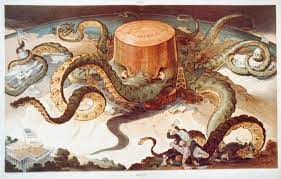
President Theodore Roosevelt’s Justice Department was planning to file an antitrust suit against Rockefeller’s Standard Oil Company in 1906, and the states wanted to get into the action before the Attorney General did. Multiple lawsuits were filed against the directors of the company that controlled over ninety percent of oil production in the United States and had, by prevailing accounts, used unfair practices to gain its monopoly in the market.

Once the floodgates of lawsuits against Standard Oil opened, the focus landed on the company’s origins and rise to power, which meant the testimony of the company’s founder was essential. And of course, having the richest man in the world dragged into your courtroom was a pretty big deal. Process servers and newsmen engaged in a massive manhunt to find him and serve him with subpoenas.

But a man with multiple estates and an annual income of over fifty million dollars could hide out anywhere. He wouldn't be found until he wanted to be found. 

Unless you followed your nose. 

On our next episode, we catch up with “The Most Famous Man in The World” as Teddy Roosevelt returns to America after his African safari and world tour to find that President William Howard Taft has made a real mess of things and just maybe, he will have to do something about it.  

Stay tuned for Teddy Roosevelt’s Third Term, Part V.


Like the show? Subscribe to the podcast and like or follow our Facebook page for more historical trainwrecks and their adventures.


Sources

American Experience. “The Cleveland Massacre.” Retrieved August 13, 2021 from https://www.pbs.org/wgbh/americanexperience/features/rockefellers-south/

Chernow, Ron. “Titan: The Life of John D. Rockefeller, Sr.” Vintage, 2007

Ohio History Central. “John D. Rockefeller.” Retrieved August 13, 2021 from https://ohiohistorycentral.org/w/John_D._Rockefeller

Tarbell, Ida M. “The History of the Standard Oil Company: Vol. 1 & 2.” Joe Barta, 2012.

Wikipedia. “John D. Rockefeller.” Retrieved August 13, 2021 from https://en.wikipedia.org/wiki/John_D._Rockefeller

Wikipedia. “Standard Oil.” Retrieved August 13, 2021 from https://en.wikipedia.org/wiki/Standard_Oil


Saturday, August 14, 2021

Podcast Episode 9 - Teddy Roosevelt's Third Term. Part IV

William Howard Taft was a nice guy who didn't really want to be President.

Turns out it was his wife, Nellie Taft, who kept getting him to turn down appointments to the Supreme Court, which was his lifelong ambition. She wanted her husband to be President more than her husband wanted to be Chief Justice of the Supreme Court, and she wore the pants in the Taft house.

By 1905, it was clear to everyone that Taft would be Theodore Roosevelt’s successor in 1908, and Nellie Taft was already “mentally redecorating the White House.”

Taft was a weak presidential candidate, and Teddy had to do a lot of the heavy lifting. Taft won, and Teddy made plans to leave the country on a year-long African safari. He knew it was best, for many reasons, for him to get out of the United States for a long while.

For many, many good reasons, Theodore Roosevelt went to Africa.


Ultimately, what would have been best for all concerned was for each man to get his heart’s fondest desire: another (and final) term as President for Teddy, after which he could finally lay down his burdens, knowing that he had done all he could. A seat on the highest court in the land for Taft, where his brilliant legal mind could do what it was always meant to do. Forcing these two square pegs into round holes created an off-kilter situation that could only be resolved through disaster.

On our next episode, we take a much-needed break from former President Theodore Roosevelt. As his contemporaries knew all too well, Teddy was exhausting, so we’ll leave him to butcher his way through Africa, slaughtering as many wild beasts as he can and go off on a tangent where Teddy only has a walk-on part, but still looms large. Because he just can’t help himself.

It’s the story of how the escape plan of the richest man in the world was thwarted by his weakness for his favorite food.

Stay tuned for John D. Rockefeller’s Favorite Cheese.

Have a listen to the History's Trainwrecks Podcast at the links or embedded players below:


Itunes:
https://itunes.apple.com/us/podcast/id1566357950?mt=2

Google Podcasts:
https://www.google.com/podcasts...

Spotify:
https://open.spotify.com/show/0EDHR8NUqtfUYbL5l3Mr28

Audible:
https://www.audible.com/pd/Podcast/B08JJMCMYV...

IHeart Radio:
https://www.iheart.com/.../269-historys-trainwrecks.../

Amazon Music:
https://music.amazon.com/.../e2a604.../history's-trainwrecks


Like the show? Subscribe to the podcast and like or follow our Facebook page for more historical trainwrecks and their adventures.


Sources


Morris, Edmund. “Colonel Roosevelt.” Random House, 2010.

Roosevelt, Theodore. “Autobiography of Theodore Roosevelt.”

Wikipedia, “William Howard Taft.” Retrieved August 9, 2021 from https://en.wikipedia.org/wiki/William_Howard_Taft

Thursday, August 5, 2021

Podcast Episode 8 - Teddy Roosevelt's Third Term, Part III

Theodore Roosevelt was riding high as the election of 1904 approached.

He had secured the Panama Canal (by helping create the nation of Panama). His only rival for the presidential nomination in 1904 was a sickly Senator. The American people loved his antics, even while establishment politicians feared he was too dangerous a lunatic to be running the country. American children, even though they couldn't vote, pestered their parents to get them a Teddy Bear, created after the President refused to shoot a wounded bear on a hunt in Mississippi.


He only had to convince the establishment Republicans he was safe. He sent Elihu Root, the most establishment Republican in the country, to get the message out. Objections to his candidacy slowly disappeared.


The Democrats nominated Judge Alton B. Parker, a gray, taciturn fellow, to run against him. On the surface, it appeared like the Judge had no chance, but Teddy knew that safe and boring was the only thing that could beat him.


Fortunately, the Democrats made a number of mistakes in the campaign. Their nominee stayed on the sidelines, and when he finally came out to fight, the only arrow in his quiver was a conspiracy theory for which he had no proof.


Theodore Roosevelt was elected in a landslide.


All he had to do now was not put his foot in his mouth in any big way.


On Election Night, without consulting anyone, he made the following statement to the press:


“On the fourth of March next I shall have served three and a half years, and this three and a half years constitutes my first term. The wise custom that limits the President to two terms regards the substance and not the form. Under no circumstances will I be a candidate for or accept another nomination.”


Well, Mr. President, I sure hope that isn’t a statement you’ll regret someday. And I REALLY hope it doesn’t cause you to do something dangerous and self-destructive in the next few years.


Fingers crossed…


Have a listen to the History's Trainwrecks Podcast at the links or embedded players below:


Itunes:
https://itunes.apple.com/us/podcast/id1566357950?mt=2

Google Podcasts:
https://www.google.com/podcasts...

Spotify:
https://open.spotify.com/show/0EDHR8NUqtfUYbL5l3Mr28

Audible:
https://www.audible.com/pd/Podcast/B08JJMCMYV...

IHeart Radio:
https://www.iheart.com/.../269-historys-trainwrecks.../

Amazon Music:
https://music.amazon.com/.../e2a604.../history's-trainwrecks


On our next episode, we enter the regretful phase of Theodore Roosevelt’s political life as he sits out the election of 1908, grows disenchanted with his appointed presidential successor, and storms the election of 1912 like a bull moose.


Stay tuned for Teddy Roosevelt’s Third Term, Part IV.


Like the show? Subscribe to the podcast and like or follow our Facebook page for more historical trainwrecks and their adventures.


Sources


Britannica.com “Free Silver Movement.” Retrieved August 4, 2021 from https://www.britannica.com/event/Free-Silver-Movement


Morris, Edmund. “Theodore Rex.” Simon & Schuster, 2006.


Roosevelt, Theodore. “Autobiography of Theodore Roosevelt.”


Wikipedia, “Alton B. Parker.” Retrieved August 3, 2021 from https://en.wikipedia.org/wiki/Alton_B._Parker#Presidential_nomination


Wikipedia, “Teddy Bear.” Retrieved August 3, 2021 from https://en.wikipedia.org/wiki/Teddy_bear